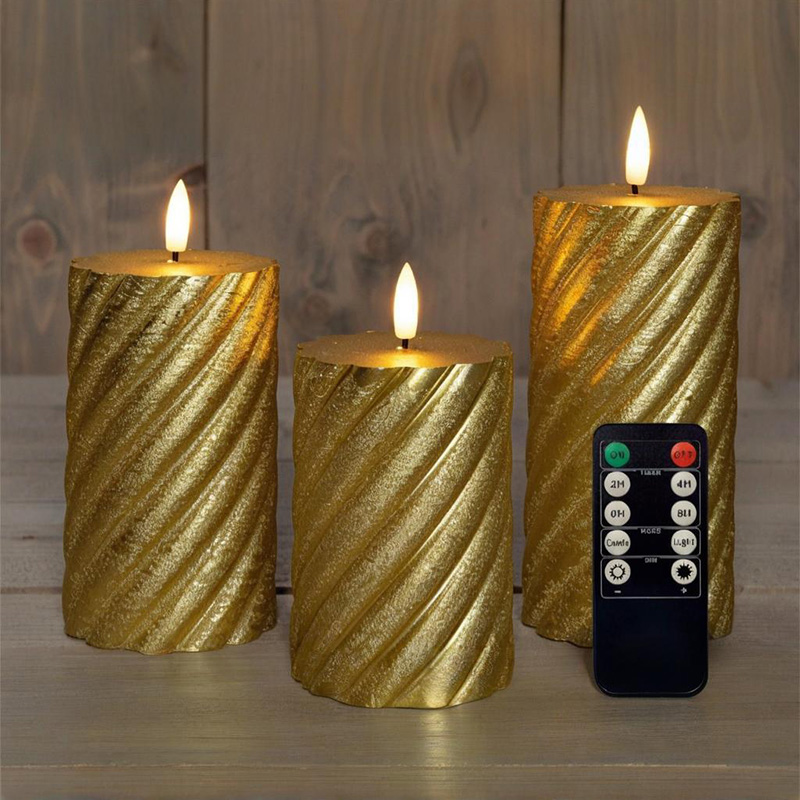
3D Wick Candles: A Conceptual Overview
The advent of 3D Wick Candles represents a significant evolution in the field of flameless illumination, blending traditional aesthetics with modern electronic innovation. This technology moves beyond the simple single-plane LED or flat wick designs, offering an enhanced, multi-dimensional realism crucial for market differentiation.
Core Knowledge and Principles
The defining characteristic of a 3D Wick Candle lies in the intricate simulacrum of a natural flame achieved through sophisticated electronic and material engineering.
Multi-Axial Movement Simulation: Unlike simpler electronic candles, a 3D wick assembly incorporates mechanisms capable of motion across multiple axes (e.g., $x$, $y$, and $z$, or rotational/tilting freedom). This allows the artificial flame element (often a thin, proprietary film or sculpted polymer) to replicate the natural flicker, sway, and dance of a real wick flame under ambient conditions. The kinetic behavior is governed by micro-actuators or magnetic levitation principles.
Gradient Illumination and Color Temperature Control: Achieving visual authenticity demands more than just movement. The system utilizes multiple light sources (typically high-efficiency LEDs) strategically positioned to cast light onto the moving "flame" element from various angles. This creates complex light and shadow gradients, mimicking the bright center and softer, glowing periphery of a real flame. Furthermore, the light sources are precisely controlled to shift subtly in color temperature (measured in Kelvin, $K$), moving between warmer ambers and cooler whites to enhance the perception of a burning wick.
Proprietary Wick Material Science: The visual element that captures the light and motion—the "wick" itself—is critical. It must possess a specific translucency, refractive index, and low mass to be easily manipulated by the motion system while effectively distributing the LED light. Materials are often composite polymers designed to diffuse light softly rather than reflect it harshly, contributing to the overall illusion.
Energy Management and Efficiency: Given the continuous movement and multi-LED architecture, the power consumption of a 3D Wick system is inherently higher than static LED designs. The system must employ advanced power regulation circuits and optimized battery management algorithms to ensure a prolonged operational lifespan, a key consumer expectation. This balance between realism and endurance is a major engineering focus.
Synergy with Ninghai Shuangmei Electronic Co., Ltd.
The successful production and market penetration of advanced products like 3D Wick Candles require a synthesis of innovative design and robust manufacturing capabilities, which is where a specialized entity like Ninghai Shuangmei Electronic Co., Ltd. becomes instrumental.
Manufacturing and Partnership Framework
Scalable Electronic Integration: Ninghai Shuangmei's expertise in electronics manufacturing is pivotal for scaling the complex internal circuitry required for 3D Wick functionality. This includes the integration of microcontrollers, driver circuits for the actuators and LEDs, and the sophisticated sensor technology sometimes used to create randomized, non-repeating flicker patterns.
Precision Electromechanical Assembly: The core motion system is electromechanical, demanding high-precision assembly processes to ensure reliable, quiet, and consistent movement of the 3D element. The company's capabilities in handling fine mechanical components and electronic sub-assemblies are essential to translating the innovative 3D design into a mass-producible product.
Flexible Customization Paradigm: The statement from Ninghai Shuangmei regarding their flexible customization service directly addresses the needs of the 3D Wick market. The $3D$ Wick concept can be applied to diverse candle body materials, sizes, and control interfaces (e.g., remote control, timer functions). The ability to offer bespoke modifications—from housing material changes to re-programming the motion profile—positions the partnership for success in serving a fragmented, high-demand decorative market.
Market Entry Strategy Support: The willingness of Ninghai Shuangmei to accept a pilot order threshold (e.g., 500 units) is a strategic mechanism to lower the barrier to entry for new market partners. This facilitates essential market testing and validation for different 3D Wick designs and customization levels before committing to larger production runs, mitigating initial inventory risk.
Frequently Asked Questions (FAQ) about 3D Wick Technology
| Aspect |
Question |
Conceptual Answer |
| Technology |
What differentiates a 3D Wick from a standard LED flame? |
A 3D Wick incorporates a physically moving element and multi-point LED lighting to create a volumetric, multi-axial flame appearance, whereas standard models typically rely on a static element or simple two-dimensional light projection. |
| Mechanism |
How is the 'flickering' motion achieved? |
The motion is generated by highly efficient micro-actuators (e.g., electromagnets or miniature motors) or a pendulum-style kinetic system that gently and randomly manipulates the lightweight wick element. |
| Aesthetics |
What is the role of light sources in realism? |
Multiple LEDs are used to create dynamic light gradients and shifting shadow effects on the moving wick material, which is critical for replicating the visual texture and depth of a natural fire source. |
| Materials |
What is the wick material typically made of? |
The visual wick is often a specialized composite polymer or film engineered for optimal light diffusion and minimal mass, ensuring responsive and silent movement within the system. |
| Safety |
Are 3D Wicks safer than older electronic candles? |
Yes, like all electronic candles, they eliminate the inherent fire risk, heat, and wax mess associated with traditional flame candles, offering a superior flameless safety profile. |
| Customization |
Can the flicker speed or light color be modified? |
Yes, advanced 3D Wick systems are controlled by microprocessors, allowing for programmable motion profiles and color temperature adjustments based on specific aesthetic requirements. |


 English
 Español